Start Prepping for 2025: How to Build a Marketing Strategy That Works for You All Year
Start Prepping for 2025
How to Build a Marketing Strategy That Works for You All Year
Make 2025 your most successful year yet by laying the groundwork now. Whether you're a solopreneur or a small business owner, this post will show you why planning ahead is crucial—and how you can set up systems that work on autopilot. Plus, grab your free Email Marketing Blueprint to kickstart your efforts today!
Don’t Let 2025 Catch You Unprepared
What Happens if You Don’t Plan for 2025
Your Roadmap to Get 2025 Started Right
What Success Looks Like in the Start of the Year Long
“2025 success is built on today’s strategy. By setting up automated systems and a clear plan now, you can ensure that your marketing consistently drives growth without demanding all your time.”
Don’t Let 2025 Catch You Unprepared
Most small marketing teams enter a new year with ambitious goals but without a clear plan. So they’re left scrambling to keep up with marketing trends or audience engagement. By MLK weekend they need a day off because they are overwhelmed, frustrated, and feel like they’re constantly behind the curve.
You shouldn’t feel like you’re starting a new year running on empty.
As someone who’s helped many businesses navigate the digital landscape, I know what it takes to create a marketing strategy that doesn’t just look good on paper—it delivers results. Let’s break down the steps you can take right now to make 2025 a win.
What Happens if You Don’t Plan for 2025?
By not having a clear marketing plan in place, you risk:
Losing touch with your audience because of inconsistent communication.
Falling behind competitors who are prepared and adapting to trends.
Missing out on potential revenue from poorly timed or rushed campaigns.
According to the 2024 Content Marketing Benchmarks, Budgets, and Trends Survey, 58% of B2B marketers rate their content strategy as only “moderately effective.” Why? Half say their strategy struggles because they lack clear goals.
That doesn’t have to be you this year.
Your Roadmap to Get 2025 Started Right
Here’s your roadmap to a successful 2025 marketing strategy:
Step 1: Figure Out Where You’re Focusing
You’re a small team, and let’s be real—you can’t do everything. Rather than spreading yourself thin, zero in on one key product or service to spotlight in Q1. Pick the offering that aligns best with your growth goals or resonates most with your audience. Maybe it’s a high-margin service, a new launch, or a bestseller you want to amplify. By focusing on one thing, you can tailor all your efforts—messaging, assets, and content—around a single campaign that hits harder, cuts through the noise, and gets your audience excited. Let this become the anchor of your Q1 marketing push.
Step 2: Frontload decisions
Get ahead by planning your talking points and gathering your assets before the year kicks off. By making decisions now—like your main messaging points, visuals, and content themes—you’ll have everything you need to keep things moving smoothly when 2025 hits. Bonus points if you can wrap this up in 2024, so you’re ready to hit the ground running! This advance prep helps you avoid last-minute scrambles and frees you to focus on execution, not decision fatigue.
Step 3: Automate what you can:
When you’re a small team, automation is your best friend. Set up systems to handle repetitive tasks, like social media scheduling and email marketing sequences, so you can stay consistent without added work. Tools like MeetEdgar or Buffer can help schedule posts in advance, while email platforms like Mailchimp or ConvertKit allow you to automate nurture sequences, welcome series, or drip campaigns. Automating frees up your time to focus on higher-level tasks, knowing that your content is getting delivered on schedule, exactly when your audience needs to see it.
Step 4: Choose KPIs
KPIs (Key Performance Indicators) are your map for knowing if you’re on the right track. Think of metrics that will directly impact your business goals for your chosen product or service. Are you looking to boost conversions, increase website traffic, or grow your email list? Choose KPIs that give you clear insights into your progress and will help you make quick adjustments as needed. Remember, picking the right metrics is about focus—it’s better to excel in a few areas than to chase everything and achieve little.
Step 5: Iterate
Even with the best-laid plans, there’s always room for improvement. Take time to review your results regularly—what’s working, what’s not? Look at your KPIs, tweak your messaging, refine your strategy, and continuously optimize your content. This isn’t a “set it and forget it” process; it’s about constantly sharpening the sword so your marketing gets better with every cycle. If something’s not working, don’t be afraid to pivot and test a new approach.
What Success Looks Like at the Start of Your Year
Imagine wrapping up Q1 with a streamlined, high-performing marketing strategy that feels manageable, aligned, and impactful. Instead of scrambling to keep up, you’ll feel ahead of the game, knowing exactly where your time and resources are going. That’s the power of focus and planning.
Ready to set your business up for 2025?
Ready to set your business up for success in 2025? Schedule a Marketing Consultation with me, and let’s make sure you’ve got a plan that drives results and keeps your team focused on what matters most.
See the Impact
Picture the end of Q1: You’ve hit your KPIs, automated the busywork, and seen real results. Your team is energized, your strategy is working, and you’re excited to keep building on that success. That’s what happens when you start the year with focus and intention.
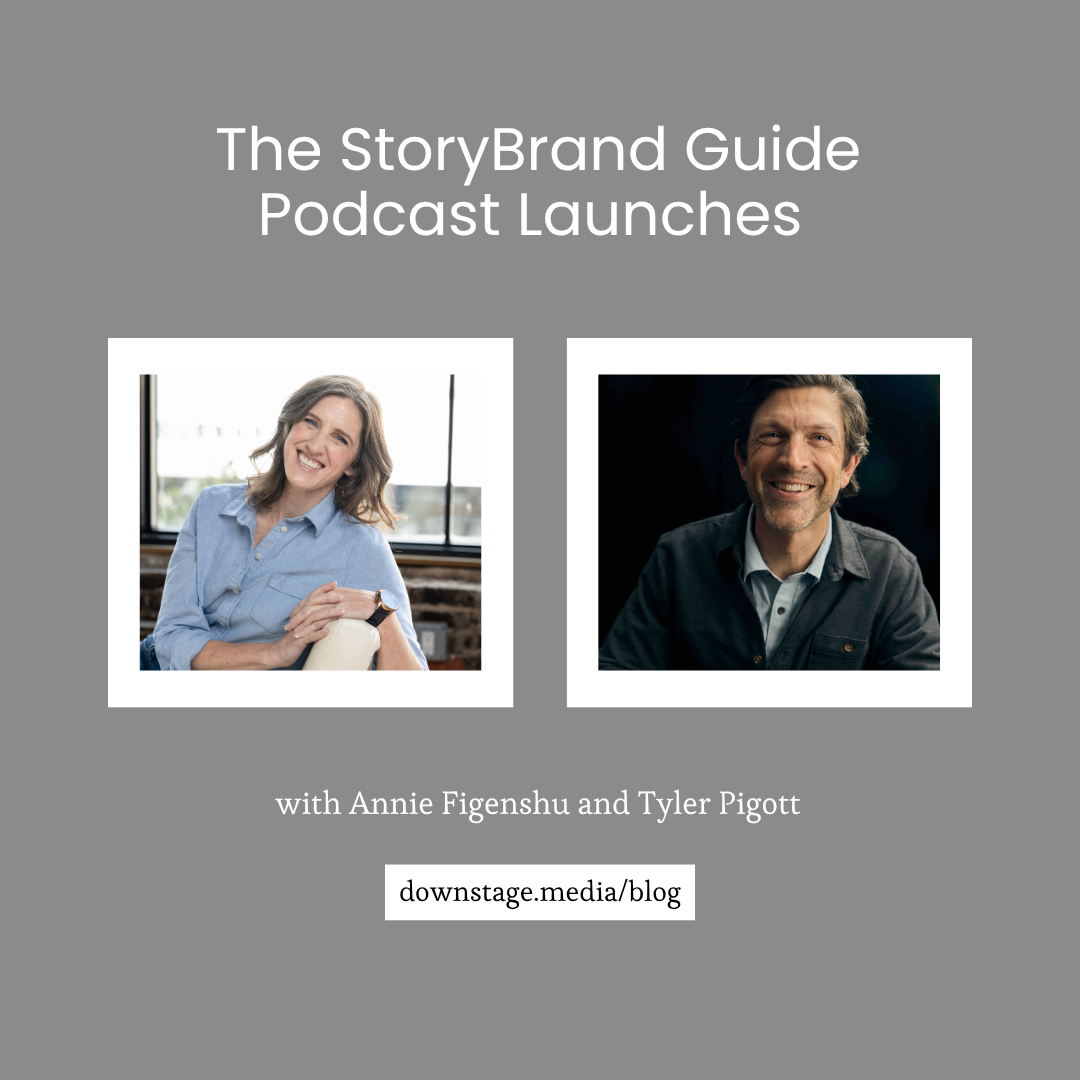
StoryBrand Guides have access to keynotes, frameworks, and tools designed to help them grow their businesses. The challenge is figuring out how to turn those resources into client work and revenue. That’s what inspired an internal StoryBrand pilot called What Does This Make Possible? Today, that idea has evolved into the StoryBrand Guide Podcast, co-hosted by Annie Figenshu and Tyler Pigott.
Should you use a StoryBrand BrandScript or the PEACE Framework? The answer depends on what you’re trying to accomplish. Learn when to use each framework, how they work together, and why understanding the difference can help you create better marketing, faster.
Most businesses aren’t losing customers because their product is bad. They’re losing customers because their marketing is too hard to understand. Downstage Media’s upcoming live session, How to Talk About Your Business So People Actually Buy, will teach founders and B2B business owners how to simplify their talking points so customers engage faster and buy with more confidence.
Most founder-led brands generate ideas faster than their teams can publish them. In this live workshop, Annie Figenshu introduces the Content Production Team framework, a simple system that helps small teams publish content more consistently without overwhelming the organization.
Content is easier to create than ever, and audiences are skeptical of its authenticity. If brands don’t adjust, their content will continue to be ignored. This post shares insights from The Marketing Algonquin, a private roundtable of New Jersey-based marketers, on the shift from creation to curation so your content earns what’s hardest to win: audience trust.
Most leaders have a hard time communicating clearly, which leads to checked out teams and missed opportunities. This post breaks down how improv principles fix that, so your ideas actually land and your audience gets on board.
New goals are easy to set in January. What’s harder is sticking to them when motivation fades later in the year. This post breaks down the three supports every business needs so progress doesn’t disappear in February, May, or the middle of summer.
If your marketing feels scattered, you’re not alone. Most experts, founders, and speakers work way too hard for far too little traction because their message isn’t clear. This guide walks you through how to use a StoryBrand BrandScript to simplify your message, strengthen your content, and make marketing finally feel doable.
Confused about StoryBrand Certified Guide vs Coach? Here’s what changed, why it changed back, and what it actually means for your marketing.
Get your business ready for 2025! In this post, you’ll learn a streamlined, five-step plan designed for small teams. From choosing your top focus to setting up automations and tracking the right metrics, each step is crafted to help you make an impact with clarity and confidence. Let’s start the new year with a marketing strategy that’s both manageable and powerful.
You like how StoryBrand makes your customer the hero, but applying that same thinking to blog posts, videos, and emails is a little murkier. This post shows how to use the StoryBrand framework as a jumping off point for your content marketing efforts. The result is customer-focused content that’s easier to create and more effective at building relationships.
After attending a retreat or conference, your head is full of fresh ideas and strategies that could drive your business forward. But without a plan to act quickly, those sparks of inspiration could fade. In this post, we’ll cover why it’s crucial to block time for implementation right after an event and offer practical steps to turn those ideas into long-term growth.
Service-based businesses often overlook holiday marketing, but with the right strategy, you can stand out, boost engagement, and increase revenue. By focusing on what your clients need for the new year and automating your marketing, you’ll position your business for long-term success. Don’t let the season pass you by—take charge of your holiday campaign today!
Get your email marketing ready for the holiday rush with a fully optimized email funnel before Halloween. Personalization is the key to boosting engagement and driving sales, as Mailchimp’s "This Holiday, It’s Personal" report shows that targeted emails can increase open rates by 29%. Start now and let your automated email campaigns work seamlessly through the busiest shopping season, leaving you free to focus on your business.
Discover how to use AI to streamline your content creation without losing the clarity that the StoryBrand framework provides. In this post, I share five steps to train AI on your brand voice and offerings, helping you create customer-focused content that converts while saving you time.
The Power of a Clear Brand Message: It's not easy to connect with your audience right now. Discover how a clear and compelling brand message can transform your business. Learn why a clear message drives revenue. Plus, learn what you must do before, during, and after you craft your brand message so you can get the most out of your marketing.
Struggling to make your sales pitches resonate? Discover the transformative power of storytelling in sales. Learn how the StoryBrand framework can help you connect with potential customers, increase engagement, and boost your revenue. Dive into our guide and register for the Close More Sales with Storytelling webinar to refine your skills and drive your business forward. Limited spots available – don’t miss out!
You want to send emails out regularly, but life gets in the way. If you don’t find a sustainable way to manage your email marketing, you risk losing potential revenue. Plus, you might find yourself stuck on the content hamster wheel, always scrambling to keep up. Evergreen content is your new best friend. Create an email automation around that content and you will be able to relax and focus on other areas of your business. Here’s how to do it.
Struggling with inconsistent messaging and low engagement in your email marketing? Discover how a BrandScript can transform your Mailchimp campaigns. Learn how clear, compelling messaging can boost open rates, click-through rates, and strengthen your brand identity. In this blog post, I'll share practical steps to implement a BrandScript and real-life success stories that prove its impact. Ready to elevate your email marketing strategy? Read on to find out how!
Ever struggled to explain what your business does in a few seconds? You're not alone! A strong one-liner is your secret weapon for capturing attention and sparking curiosity. In this post, we explore the importance of a one-liner and how our Pitch Perfect One-Liner Workshop can help you craft a compelling message that resonates. Learn about common challenges, our proven framework, and hear success stories from those who’ve transformed their business communication. Don’t miss this opportunity to make a memorable impression and elevate your marketing game!
Marketing budgets are tight right now. A recent Gartner survey of 395 CMOs and marketing leaders shows the average 2024 marketing budgets have dipped to 7.7% of overall company revenue, down from last year's 9.1%. That means that you have to be absolutely clear on how to make the most of your marketing to make it count.
In this blog post, I’m going to talk about the StoryBrand Marketing Livestream as a way to get the most out of your marketing dollars for the rest of the year.
Our email inboxes and social media feeds are overloaded with marketing advice. It’s easy to tune it all out. But small adjustments to your content marketing strategy can make a big difference in your results. In this blog post, you’ll learn about Downstage Media’s PAGER zine and how you can get practical, tactical ideas sent straight to your door.
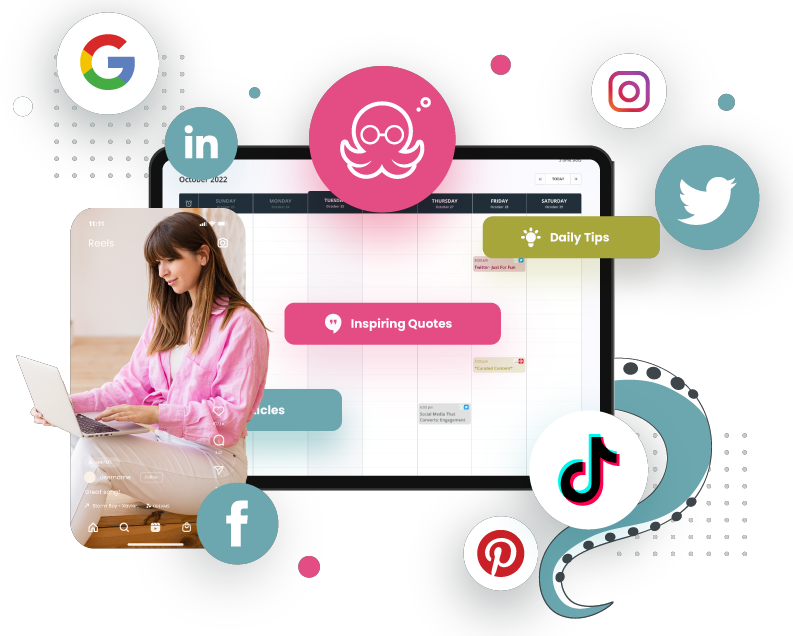
Business owners hate how much time social media eats up in their day-to-day operations. Automating content - versus simply scheduling it - frees up hours every week. At Downstage Media, our favorite tool for scheduling and automating content is MeetEdgar. Let’s break down specifically how we use it with the PAGER method for our clients, so you can figure out if it’s the right tool for you.
If you had a goal of going to the gym regularly, you wouldn’t start by going seven times a week. Or, if you did, you probably wouldn’t be able to keep that up for long. Posting on social media is the same way. In this blog post, you’ll learn a sustainable way to post 4-5 times a week. By gradually building up to this pace you’ll be able to keep up with both your social media marketing and everything else you have to do in your business.
Building customer relationships. Growing audience. Growing customer relationships. Building audience. That’s the marketing mantra for many companies. If you’re not building relationships with your current customers, you are always on the lookout for new ones. And if you’re always on the lookout for new customers, you are missing out on opportunities to keep your customers coming back to you.
Let’s break down the final stage of the 3-Stage Marketing Strategy. Here we’ll discuss ongoing content and sales so that you know what to focus on in your marketing in order to build relationships and grow audiences. Or, is it the other way around?
Some online summits are a little… thin with speakers pitching more than presenting. It’s hard to know if the Coach Builder Summit is going to be worth carving out two days of your schedule for. Let’s go through what Coach Builder Summit is, plus give you 5 insider tips you may not have considered. When you see more info about it cross your desk, you'll be confident that you thought through your decision.
You’ve heard that social media posts with links in them don’t get in front of as many people. So what can you do? Read this blog post for step-by-step instructions on how to make no click content with the PAGER method so your reach doesn’t get throttled.
Simple Social Media is available for pre-sale and you are thinking of getting a copy for yourself. Something weird is going on, though, on the website it says that you can buy them in bulk - in groups from ten to two hundred. Now why in the world would you need that many copies of one book? Here you’ll learn why multiple copies will benefit you and your business.
Get the scoop on why the book Simple Social Media won’t be available on Amazon at first, what to expect when it does become available, and why that is good for you! Learn how SMBs will benefit from this new marketing resource!
A packed workday doesn’t necessarily mean you’re growing your consulting business. Here are three activities to make time for more often than not so you can create revenue, stay in front of prospective clients, and develop relationships that lead to new opportunities.
StoryBrand Guides have access to keynotes, frameworks, and tools designed to help them grow their businesses. The challenge is figuring out how to turn those resources into client work and revenue. That’s what inspired an internal StoryBrand pilot called What Does This Make Possible? Today, that idea has evolved into the StoryBrand Guide Podcast, co-hosted by Annie Figenshu and Tyler Pigott.
Should you use a StoryBrand BrandScript or the PEACE Framework? The answer depends on what you’re trying to accomplish. Learn when to use each framework, how they work together, and why understanding the difference can help you create better marketing, faster.
AI adoption is accelerating, but without clear positioning and documented messaging, it simply scales confusion. Drawing on new books by Allison Shapira, David Newman, and Erika Heald, this post explains why AI strategy for leaders starts with judgment, differentiation, and strong content foundations.
Being everywhere with your marketing sounds ambitious, but it often leaves teams stretched too thin and messages unclear. A focused marketing strategy helps people understand what you’re known for and gives your team room to do better work.
If your marketing feels scattered, you’re not alone. Most experts, founders, and speakers work way too hard for far too little traction because their message isn’t clear. This guide walks you through how to use a StoryBrand BrandScript to simplify your message, strengthen your content, and make marketing finally feel doable.
Annie Figenshu is keenly aware that many companies are pressed for time, and every minute counts. She helps brands make the most of their content marketing so that their hard work is shared with the world. Annie is certified in both StoryBrand and Mailchimp, has two kids with Beatles-themed names, and is afraid to think what a day without coffee would look like.
A packed workday doesn’t necessarily mean you’re growing your consulting business. Here are three activities to make time for more often than not so you can create revenue, stay in front of prospective clients, and develop relationships that lead to new opportunities.